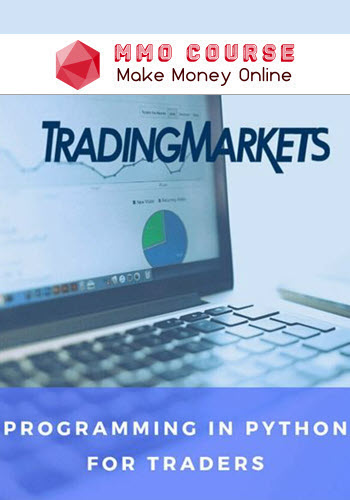
Trading Markets – Programming in Python For Traders
$119.00
Total Sold: 1
Delivery: Instant Delivery
Description
Trading Markets – Programming in Python For Traders
- Do you already program in Python?
- Do you program in TradeStation?
- Do you program in Amibroker?
- Would like to learn to program?
Python has become the hottest programming language on Wall Street and is now being used by the biggest and best quantitative trading firms in the world. We’re going to teach you the benefits of Python and how it can make you a more successful trader and allow you to build better trading strategies.
Why Python Is The Language of Choice By Many Of The Biggest and Best Trading Firms In the World
The best trading firms in the world have the resources and capabilities to program in any language.
They also have the ability to hire the best and smartest traders in the world. When you look at who they’re hiring, there’s one major theme; they’re hiring traders with Python Programming skills.
You only have to look at the professional job boards to see this.
Many of the top firms are now all requiring their traders and researchers to program in Python.
The reason they’re doing this is they obviously believe Python is leading to greater trading profits.
“The Best Coding Languages to Learn for Traders in Banks, Hedge Funds and HFT Firms” by Rob Carver – former head of fixed income at multi-billion dollar quantitative hedge fund AHL, and the author of the two books, Systematic Trading and Smart Portfolios.
“Python is the preferred language of many quantitative traders because of the extensive availability of packages for data analysis”
We can show you dozens of these examples, and now tens of thousands of professionals at the top trading firms around the world do their programming in Python (not in retail products like TradeStation, Amibroker, etc.).
If you’re serious about your trading, and want to join the elite trading professionals around the world, (and not a bunch of retail traders) then learning Python is a must.
If not, you’re falling behind!
Briefly Our Story
Chris and I are a generation apart yet our journey is the same.
Amibroker and Excel have been good to me and my clients for years. TradeStation was good to Chris for years. But we both realized in order to keep up with the professional quant firms, we needed to move to an open source professionally used language.
That language, as so many major quant firms have found, is Python.
What You’ll Learn In The Programming in Python For Traders
Week One – You’ll gain the foundation in order to do your backtesting, research and signal generation.
This foundation will lay the groundwork for you to scale into the upcoming weeks.
Your homework will include learning how to do technical analysis calculations in Python including moving averages, RSI, and the other major technical indicators used by professionals.
Week Two – You’re going to be backtesting in Python!
You’ll be writing code in Python and testing strategies and signals to find market edges. For example, you’ll be writing code using a 2, 3, or 4 period RSI on various levels, such as RSI below 30, RSI below 20, etc.
By the end of week 2, you’ll be able to test various market conditions (for example overbought and oversold conditions) and calculate the historical edges that exist in those conditions.
Week Three – You’ll be writing full fledged trading strategies. This includes allocating capital to trades, adding risk management tools, and analyzing portfolio returns.
At the end of Week 3, you will be able to run more advanced backtests of your trading ideas and strategies.
Week Four – In Week 4 you’ll be analyzing your backtests. This includes analyzing your cumulative returns, analyzing your risk (drawdowns, volatility, etc.), analyzing correlations through time, and a deep dive into analyzing individual signals in order for you to see when and how to best optimize your trading strategies.
Week Five – In Week 5 you’ll be writing more advanced backtests. This includes creating signal list generation and managing a portfolio of multiple securities. You’ll also learn advanced concepts on position sizing in order for you to optimize the edges you are finding in your strategies.
By the end of this course you will have the ability to find your own market edges, build your backtest, and do a deep analysis of the test results.
Sale Page: Trading Markets – Programming in Python For Traders
Delivery Policy
When will I receive my course?
You will receive a link to download your course immediately or within 1 to 21 days. It depends on the product you buy, so please read the short description of the product carefully before making a purchase.
How is my course delivered?
We share courses through Google Drive, so once your order is complete, you'll receive an invitation to view the course in your email.
To avoid any delay in delivery, please provide a Google mail and enter your email address correctly in the Checkout Page.
In case you submit a wrong email address, please contact us to resend the course to the correct email.
How do I check status of my order?
Please log in to MMOCourse account then go to Order Page. You will find all your orders includes number, date, status and total price.
If the status is Processing: Your course is being uploaded. Please be patient and wait for us to complete your order. If your order has multiple courses and one of them has not been updated with the download link, the status of the order is also Processing.
If the status is Completed: Your course is ready for immediate download. Click "VIEW" to view details and download the course.
Where can I find my course?
Once your order is complete, a link to download the course will automatically be sent to your email.
You can also get the download link by logging into your mmocourse.hk account then going to Downloads Page.
Related products

![Simpler Trading - Ready Aim Freedom [Strategy Class + Indicator]](https://mmocourse.org/wp-content/uploads/2023/02/Simpler-Trading-Ready-Aim-Freedom-Strategy-Class-Indicator.jpg)
Total sold: 2